FDI Blackout: What Britain’s Silence Says About Sierra Leone
Foreign Direct Investment is not just a line in a spreadsheet; it is a verdict on a country’s credibility. And the latest UK figures deliver a sobering message: for two straight years, the United Kingdom has had no publishable FDI stock in Sierra Leone. Not low—undisclosable. Too small, too thin, too insignificant to meet reporting thresholds.
For a country that markets itself as “open for business,” this is not a footnote. It is a warning.
The UK’s Department for Business & Trade has now published two consecutive factsheets—2024 and 2025—without a single outward FDI figure for Sierra Leone. Meanwhile, Sierra Leone’s own investment position in the UK has collapsed from £2 million to £1 million.
This is not a bilateral investment relationship. It is a rounding error.
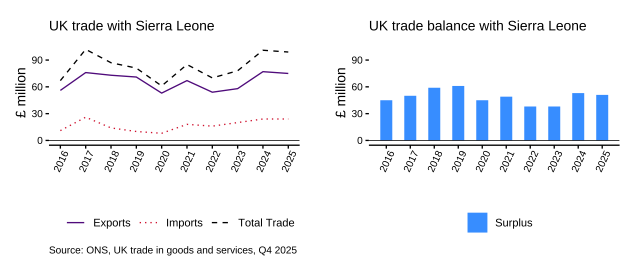
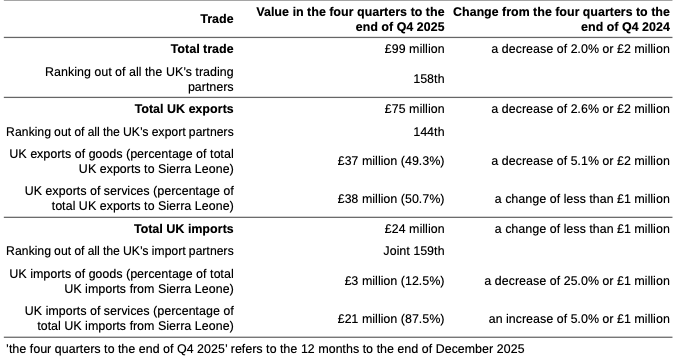
And it comes at a time when Sierra Leone is aggressively courting capital for mining, energy, logistics, and infrastructure. Investors are watching. They see the political noise. They see the regulatory uncertainty. They see the slow pace of reforms. And they are voting with their wallets. Yes, trade between the two countries remains steady at around £99 million. But trade is transactional. Investment is transformational. Trade buys goods. Investment builds factories, ports, power plants, and jobs.
Sierra Leone cannot trade its way into prosperity while investment flatlines.
A country without meaningful FDI inflows faces three hard truths: • Growth slows because domestic capital is too small to drive structural transformation. • Debt rises because government becomes the only engine of development. • Jobs stagnate because private-sector expansion never takes off.
This is the trap Sierra Leone risks falling into: a low-investment, high-debt, low-growth equilibrium. If Sierra Leone wants to reverse this trend, it must treat the UK’s silence as a diagnostic tool, not an insult. The path forward is clear:
1. Fix the investment climate, not the messaging Investors are not persuaded by slogans. They are persuaded by predictability. Sierra Leone must deliver regulatory stability, contract enforcement, and transparent licensing regimes—especially in mining and energy.
2. Build investor grade institutions A modern investment regime requires: • a credible one stop investment window • faster approvals • digitalised processes • independent dispute resolution mechanisms Without these, capital will continue to bypass the country.
3. De-risk private investment through blended finance Sierra Leone should aggressively pursue: • partial credit guarantees • political risk insurance • co-investment platforms with DFIs This is how frontier markets attract capital in a risk averse world.
4. Professionalise economic diplomacy The UK is one of Sierra Leone’s most important partners. Yet the investment relationship is anaemic. Sierra Leone needs investment attachés, not ceremonial envoys—professionals who can pitch bankable projects, negotiate partnerships, and build investor pipelines.
5. Signal seriousness through reforms, not rhetoric Investors respond to actions: • stable macroeconomic policy • credible fiscal discipline • transparent procurement • anti-corruption enforcement These are the real “incentives.” The Bottom Line
The UK’s two-year FDI silence is not a statistical quirk. It is a mirror. And Sierra Leone must look into it honestly.
If the country wants to attract serious capital, it must become a serious destination. In the global marketplace, investment does not follow hope—it follows confidence.